


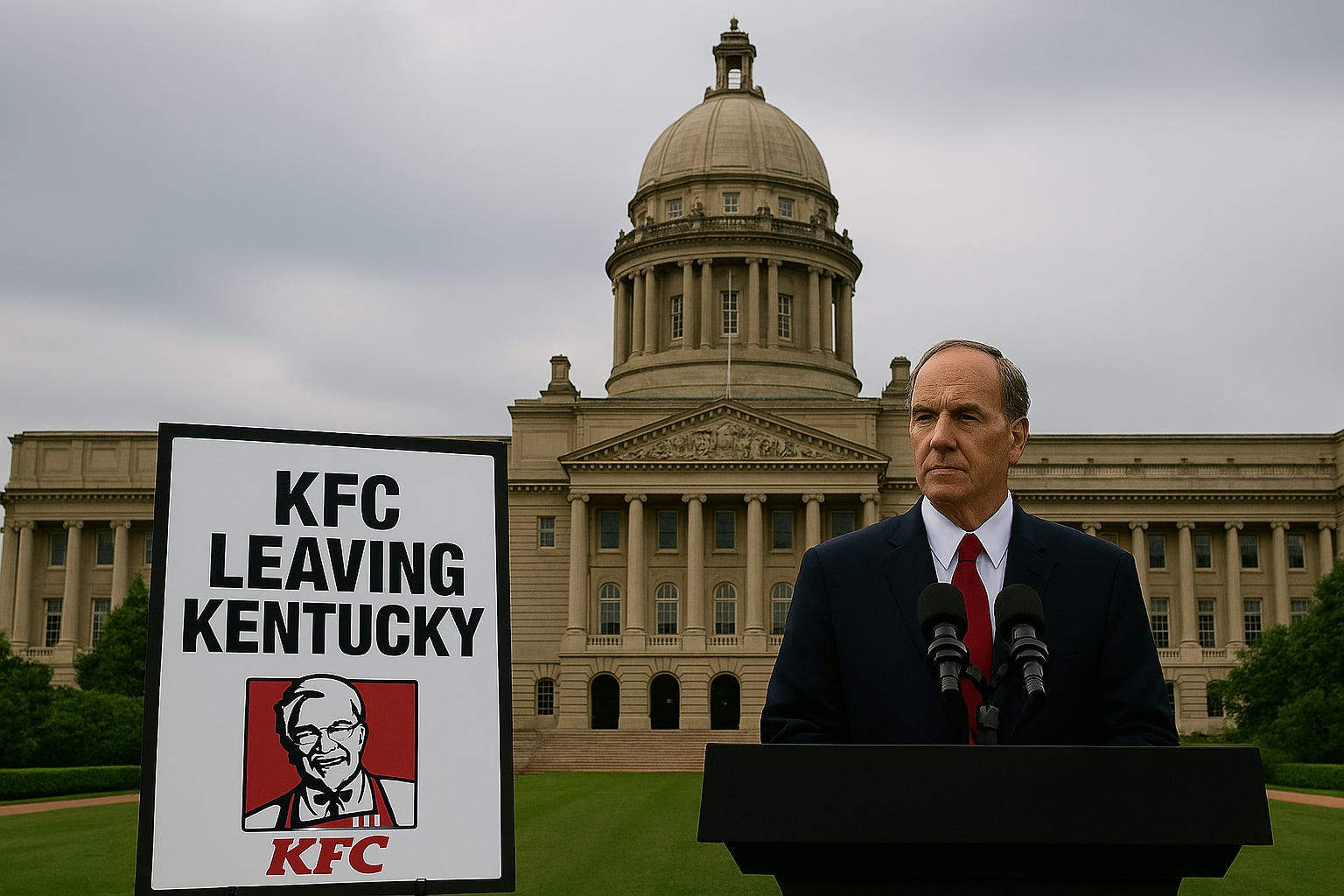
LOUISVILLE, Ky. (AP) — Six years before its 100th anniversary, Kentucky Fried Chicken announced Monday it will relocate all operations out of the Commonwealth, citing a little‑noticed state law set to take effect March 1.
The measure — passed quietly in the final hours of last year’s legislative calendar — escaped public attention for nearly eleven months. It resurfaced only last week when a team of KFC attorneys, snowed in during a winter storm, began playing what they described in internal emails as “a lighthearted game of Spot‑the‑Statute” to pass the time while billing the company for the hours.
According to those emails, the attorneys were several rounds into the game when one of them read aloud a clause from the Kentucky Poultry Purity and Consumer Protection Act and asked, “Wait… does this say what I think it says?”
It did.
KRS 257.482(4)(b):
“For the protection of consumers, all chickens, chicken‑derived products, and chicken‑adjacent materials destined for human consumption must be certified as containing no DNA, genetic matter, or other substances associated with heredity or molecular replication.”
The new law spells out that any presence of DNA constitutes a violation, a phrase the attorneys initially assumed was a drafting error before realizing the bill’s language had been signed, enrolled, and scheduled to become enforceable in less than five weeks.
Agricultural scientists noted that the definition applies to all living organisms, including chickens, corn, legislators, and the people who voted for the bill.
“We understand the intent was to target genetically modified poultry,” said Dr. Elaine Mercer, a University of Kentucky biologist. “But as written, the law bans chickens.”
KFC, founded in Corbin in 1930, said the company had “no viable path forward” under the new statute.
“We cannot comply with a law that prohibits the existence of chickens,” the company said in a statement. “Our entire menu is now classified as contraband.”
State officials insisted the “radical left‑wing media” was misrepresenting the bill, accusing national outlets of “spreading alarmist rhetoric to scare people into thinking chickens need DNA to function.”
“This is the same playbook they always use,” said Rep. Dalton Hargis, the bill’s sponsor. “The left hears one thing they don’t understand, panics, and then tells everyone the sky is falling. Well, we’re not going to let fearmongering dictate policy in Kentucky.”
Hargis added that Kentuckians “know better than to trust coastal reporters who probably couldn’t tell a chicken from a pigeon,” and said the public should “ignore the usual noise — you know how they get.”
When asked how a gene‑free chicken would function, Hargis said he was “not a scientist” but believed “the free market will innovate.”
The Kentucky Department of Agriculture has begun preparing enforcement guidelines, including a 24‑hour hotline for reporting “suspiciously complex poultry.” Inspectors will be equipped with DNA swabs, though officials acknowledged they are still determining what to do if a chicken tests positive for being alive.
Local farmers expressed confusion.
“I’ve raised chickens for 40 years,” said Laurel County farmer Jim McCready. “Every one of them had genes. I asked the state what I’m supposed to do now, and they told me to ‘check back next session.’”
The KFC announcement appears to have triggered widespread closures throughout the industry. Chick‑fil‑A, Popeyes, and hundreds of grocery store meat counters have announced temporary shutdowns while attorneys review the statute. Tyson Foods issued a brief statement reading, “We are monitoring the situation,” followed by a second statement 2 minutes later reading, “Actually, never mind, we’re leaving too.”
Despite the backlash, legislative leaders defended the bill as a victory for consumer safety.
“Kentucky will not be bullied by Big Chicken,” said Senate Majority Leader Mark Whitford. “If other states want to sell gene‑infested poultry, that’s their business. Here in Kentucky, we believe in purity.”
Whitford also confirmed lawmakers are considering a similar measure this summer aimed at beef products. A draft circulating among committee members would prohibit the sale of “cattle containing bovine DNA,” a provision ranchers warn would outlaw every cow in the state.
Lawmakers dismissed those concerns, arguing that “bovine DNA” is a separate issue from cows. “We’re not banning cows,” said Rep. Hargis. “We’re banning bovines. Totally different thing.” He then added that critics were “overreacting” and that the terminology was intentionally precise. “If bovine DNA is so harmless,” he said, “why does it have a fancy science name.”
Ranchers expressed frustration at the distinction.
“Bovine means cow,” said McCready, pausing for several seconds. “It just means cow.”
KFC has not announced where it will relocate, though company officials hinted at Indiana, “a state that allows chickens to have DNA without government interference.”
Subscribe now | Share article | Share Publication | Comment | Message me